
HVAC job running late? Replan the remaining calls
Replan an HVAC day after a repair runs late. Check travel, breaks, parts and customer windows before moving the next visit to another technician.

Your technician's repair is going to take longer than booked. The next customer is still expecting the original arrival window. Get the new finish estimate, check the remaining calls with travel and breaks included, and move the first appointment that can no longer meet its promise.
Call the affected customer before accepting the revised route. A different name on the dispatch board does not tell them who is coming or when.
Move the call that another technician can cover
Take a made-up HVAC service team with Nia and Joel working 08:00–16:30. Lunch is protected from 12:00 to 12:30. Nia started a repair at 08:30. It was booked to finish at 10:30, but she now expects 11:30 and needs another ten minutes to close the job.
Nia has Oak next: an hour of planned maintenance, with an arrival window of 10:30–11:30. Later she has Beech, a ninety-minute repair with arrival between 13:00 and 14:00 and a firm finish by 15:00. Nia carries Beech's required part. Moving Beech to Joel would need a parts transfer, so keep that visit with her for this comparison.
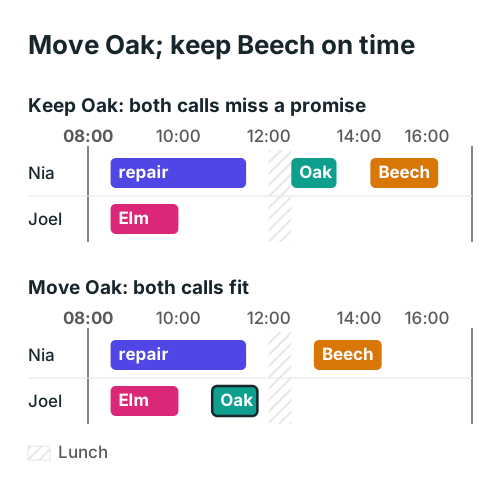
Joel is signed off for Oak's equipment and carries the required inspection kit. His morning visit, Elm, ends at 10:00, followed by fifteen minutes of paperwork. Oak is thirty minutes away. He can arrive at 10:45 and finish at 11:45, inside its arrival window and before lunch.
The figure shows service blocks. The calculations also include travel, paperwork and the protected break.
| Remaining visit | Customer promise | Keep both with Nia | Move Oak to Joel |
|---|---|---|---|
| Oak, sixty minutes | Arrive 10:30–11:30 | Arrive 12:30, finish 13:30 | Joel arrives 10:45, finishes 11:45 |
| Beech, ninety minutes | Arrive 13:00–14:00; finish by 15:00 | Arrive 14:15, finish 15:45 | Nia arrives 13:00, finishes 14:30 |
Oak's customer accepts Joel and the 10:45 arrival before dispatch confirms the move. Both remaining visits can then keep their original promises. Without that acceptance, the new assignment remains a proposal and dispatch needs another agreed option.
Check the whole remainder, including the drive home
After the delayed repair, Nia closes the job at 11:40. Oak is twenty minutes away, which puts her there at noon. Because Oak needs a continuous hour and lunch starts at noon, her first usable start is 12:30. That is sixty minutes after the end of Oak's promised arrival window.
Oak finishes at 13:30. Fifteen minutes of wrap-up and thirty minutes of driving put Nia at Beech at 14:15. She misses its arrival window by fifteen minutes and finishes forty-five minutes after its deadline. The board can still display both calls, but the promises no longer fit.
With Oak reassigned, Nia closes the first repair at 11:40, takes lunch as planned and drives to Beech from 12:30 to 13:00. The repair finishes at 14:30, paperwork at 14:45, and a thirty-minute return drive gets her back at 15:15. Joel finishes Oak at 11:45, records its fifteen-minute wrap-up before lunch, and has no other booked work in this example.
Use a fresh drive estimate from the technician's actual location. Do not reuse the travel time from the morning's original route after changing the order of calls. Then check the next visit and return requirement; fixing Oak while leaving Beech late would only move the complaint down the board.
Write down what the customer was promised
An arrival window and a finish deadline need separate fields. Oak accepts an arrival between 10:30 and 11:30; its hour of work follows that arrival. Beech also has a latest finish, so dispatch must check both ends of its visit.
Microsoft's Field Service time-constraint documentation describes promised windows as arrival and start windows. That is how those fields work in that product. Check what your own board means before assuming a window end is the time a repair must be complete.
Copy these fields onto the affected booking, or into a shared dispatch note if the board cannot hold them:
| Record | What dispatch needs |
|---|---|
| Current job | New finish estimate, remaining work and time last checked |
| Next visit | Arrival window, any finish deadline and expected work duration |
| Candidate technician | Qualification, parts, location and next free time after wrap-up |
| Revised route | Travel, break, service, wrap-up and return times |
| Customer contact | Agreed technician and arrival, who confirmed it and when |
Keep the original promise alongside the revised booking. Otherwise the new board makes the delay disappear from view even though the customer experienced it.
Set a useful overrun call-in rule
Ask technicians to contact dispatch when their new estimate puts the next promised arrival at risk. They should give the remaining work and a realistic finish, rather than just saying they are "running behind." Dispatch can then calculate the next arrival without repeatedly interrupting the repair.
Before reassigning a call, confirm the replacement's qualification and parts. A free square is only the start of that check. Microsoft's schedule assistant uses availability, skills, location and estimated travel when recommending resources; its documentation also warns that manually booking outside recommended slots does not enforce those checks.
If Joel's morning visit runs over too, recalculate his route before promising Oak. If nobody can meet the original window, tell the customer what is possible and agree a new visit. Keep the current repair safe and complete; a scheduling gap does not justify rushing its work or dropping required checks.
For recurring maintenance, the cleaning route example shows how repeat dates can load some days more heavily than others. Today's repair still needs a separate check against today's promises.
At the next overrun, write down the new finish, calculate the next arrival, and check a qualified replacement. Confirm the customer's revised visit and send the accepted route to both technicians. Leave the original promised times where you can compare them with what happened.
The example team is made up; its times were checked by recalculating the schedule.