
ERP vs APS: test your production scheduling needs
Compare your ERP scheduler and an APS with the same jobs, material delay and calendars. Check feasible dates, data ownership, edition and setup costs.
Your ERP holds the orders, but the usable production schedule still lives in separate spreadsheets. You're considering advanced planning and scheduling (APS) software because the dates keep falling apart. Give your ERP's scheduler and an APS the same jobs, calendars and material delay, then compare whether each produces a feasible plan that the floor can follow.
Start by checking the scheduler you already own. An ERP can include finite scheduling: Microsoft's Dynamics 365 documentation describes both finite capacity and material checks. The label "ERP" does not tell you whether those checks are present, licensed or configured in your installation.
Give both systems the same awkward morning
Use a made-up fabrication shop with Sam on the laser and Maya on the press. Both work 08:00–12:00 and 13:00–17:00. Each stays with their machine during its operations, including setup. Material for cutting is released before the shift. Operations transfer as whole batches and cannot cross lunch.
The laser sequence is fixed for the test. Eighteen brackets run from 08:00 to 09:00, twelve panels from 09:00 to 10:30, and six covers from 10:30 to 11:30. Those totals include setup. The press needs ninety minutes for the brackets, ninety for the panels and sixty for the covers.
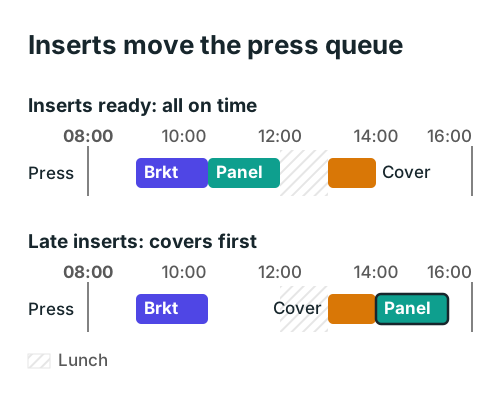
Before the delay, the brackets use the press from 09:00 to 10:30, panels from 10:30 to 12:00, and covers from 13:00 to 14:00. All orders meet their due dates. Now change one fact: the purchased inserts needed at the panel press operation will be released at 11:30.
| Order | Laser: setup + run | Press: setup + run | Due | Finish with inserts ready on time |
|---|---|---|---|---|
| 3101, eighteen brackets | 15 + 45 minutes | 30 + 60 minutes | 11:00 | 10:30 |
| 3102, twelve panels | 30 + 60 minutes | 30 + 60 minutes | 12:00 | 12:00 |
| 3103, six covers | 15 + 45 minutes | 15 + 45 minutes | 14:00 | 14:00 |
The panel operation now needs ninety continuous minutes after 11:30. It cannot fit before lunch. The covers leave the laser at 11:30 and need an hour on the press, so they cannot use the remaining morning gap either.
Ask which late orders the plan chooses
Two feasible afternoon sequences give different results. State what matters before choosing between them. For this test, compare the total minutes late across the three orders, keeping their original due times.
| Afternoon press sequence | Panel finish and minutes late | Cover finish and minutes late | Total minutes late |
|---|---|---|---|
| Panels 13:00–14:30, covers 14:30–15:30 | 14:30; 150 | 15:30; 90 | 240 |
| Covers 13:00–14:00, panels 14:00–15:30 | 15:30; 210 | 14:00; 0 | 210 |
Covers first gives the lower total in this comparison. It also makes the panels later than panels first would. If the panel customer has a hard delivery cutoff, that may change the decision. Keep the conflict visible instead of letting a software score decide which customer matters.
These are checked schedules for an invented shop. They are not results from running either product. Ask each supplier to reproduce them, explain any different result and show the rules behind it. A genuine improvement may come from another feasible sequence; a missing material constraint is a failed test.
Compare the work each route leaves you
An ERP scheduler may already solve the timing problem once the calendars, resource requirements and material rules are set correctly. A separate APS may offer a better fit for the constraints or comparisons you need. Siemens describes Opcenter Scheduling as building schedules around resource, constraint and material availability; that description is a starting point for a demonstration, rather than proof that it models your shop.
| What to ask for | Existing ERP scheduler | Separate APS |
|---|---|---|
| A feasible result for the test | Exact module, settings and resource rules used | Exact product, edition and constraint model used |
| A material-ready time that moves | How availability reaches the operation | How the changed value arrives from the source system |
| A revised plan the floor can trust | Where the accepted sequence appears | How the accepted sequence returns to the execution system |
| A correction after a bad input | Who owns the source record and reruns the plan | Who fixes the source and handles a failed transfer |
| A supportable cost | Missing licences, setup, training and support | Licences, connector work, setup, training and ongoing support |
Get a written quote against the demonstrated edition and scope. Neither a category comparison nor a basic licence price settles the cost of implementing your calendars, routings and data exchange. Do not compare one supplier's full implementation with another's subscription alone.
If people already use the ERP to record stock and order progress reliably, test keeping those records there. For an APS trial, choose who owns each field and how a rejected or failed update is reported. Ask the supplier to change the insert release in the source, bring it into the schedule, accept a new sequence and show it where the operators actually look.
Fix missing inputs before buying a new scheduler
A tool cannot use a release time nobody records. Pick a small set of real orders, check the routing and remaining work with the floor, and make the material and drawing holds explicit. A current WIP record helps establish what has actually reached the next operation.
Include people wherever attendance matters. A machine-only plan may look feasible while its only qualified setter is working elsewhere. Keep people and workspace booked together when both are needed. If you cannot supply those facts for the trial jobs, use the trial to identify the missing inputs before committing to a wider rollout.
For your next demonstration, send both suppliers the same operation list and ask them to:
- Produce the original feasible schedule without changing due dates.
- Move the panel insert release to 11:30 and keep lunch protected.
- Show every affected finish and the customer trade-off.
- Return one accepted plan to the place the floor uses.
- Name the edition, setup work, data owner and support cost behind the result.
Keep the results beside your choice of planning method. Configure the existing scheduler if it passes and people can maintain it. Trial a separate APS where the existing route fails a requirement you have demonstrated.
The example shop is made up; its times were checked by recalculating the schedule.