
Maintenance scheduling: agree downtime with production
Agree a maintenance window that includes stopping, safe access and restart. Use a checked example and a booking table to protect the next production order.
The PM is on today's list, but production still needs the machine. Agree when the machine will be handed over and when it must be ready to run again, then check that the whole job fits between those times. Count stopping, safe access and restart as well as the maintenance task.
A forty-five-minute gap cannot hold this job
Take a made-up packaging shop. Priya runs the tray sealer, and Leon is the maintenance technician qualified for its planned service. They work 08:00 to 16:30, with lunch from 12:00 to 12:30. The approved job plan calls for fifteen minutes to stop and establish safe access, forty-five minutes of maintenance and fifteen minutes for checks, restart and handover. Those estimates belong to this example; use your site's approved procedure and estimates for the actual machine.
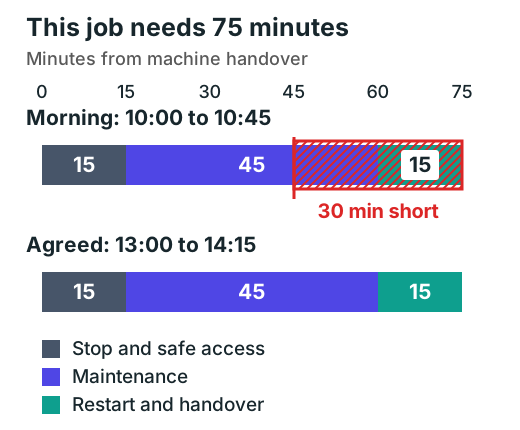
The morning tray order is already running and finishes at 10:00. The next order, seventy-five minutes of packing, is booked from 10:45 to noon and due at noon. Production offers the gap between them. Leon's maintenance task alone would fit, but the full stop takes seventy-five minutes. Starting at 10:00 would keep the sealer until 11:15, thirty minutes into the next order's booking.
That order would then run from 11:15 to noon and resume after lunch, finishing at 13:00. Its original noon promise would be missed by an hour. This shop confirms that packing can pause at lunch; the maintenance sequence must stay together.
Production also offers 13:00 to 14:15. Leon and Priya are both available, the service kit and tools are ready, and the maintenance lead has confirmed that completing this planned work by 15:00 is acceptable. Booking the afternoon window keeps the packing order on time and returns the sealer at 14:15, forty-five minutes before that maintenance deadline.
| Part of the afternoon stop | Start | Finish | Who is needed |
|---|---|---|---|
| Stop and establish safe access | 13:00 | 13:15 | Leon and Priya |
| Planned maintenance | 13:15 | 14:00 | Leon |
| Checks, restart and handover | 14:00 | 14:15 | Leon and Priya |
Priya can do other work during the middle stage, provided she is back for restart. The sealer stays unavailable throughout. No production order can use the middle of that booking just because the operator is free.
Give production a start and a return time
"Can we have the machine after this batch?" leaves the next start unresolved. Ask for a window with an agreed return time: "Can you hand over the sealer at 13:00 and keep it out of the production plan until 14:15?"
Put the same booking on the maintenance plan and the production board. Name who releases the machine and who accepts it back. In a small shop, the planner and production lead may be the same person; the handovers still need an owner.
This approach also matches the way Microsoft describes maintenance downtime: a start and end time during which the affected assets are unavailable for production. The documentation also separates worker capacity and spare-parts forecasts. A machine window and a technician assignment need to agree.
Copy this booking into the day plan
Use one row per stop in the board or system you already use. Keep the detailed maintenance procedure in the work order; the schedule needs enough information for production to honour the booking.
| Field | Sealer example |
|---|---|
| Asset and work order | Tray sealer; planned service |
| Production release | Priya hands over at 13:00 |
| Ready to run again | 14:15, including restart checks |
| People | Leon throughout; Priya at release and restart |
| Readiness | Service kit and tools checked; approved job plan available |
| Latest acceptable completion | 15:00, confirmed by the maintenance lead |
| If the window changes | Production lead and Leon agree a revised booking before work starts |
Confirm that parts are physically ready, required people are available and the site has authorised the work before changing the booking to confirmed. IBM's maintenance scheduling guidance also places equipment access and material confirmation before assigning the work. An expected delivery is still a dependency to check.
For the wider day plan, collect the scheduling inputs that affect both teams: actual batch finish, staff availability and the next production promise. If several people must attend together, use the same shared-resource check as you would for a production operation.
When production runs late or a breakdown takes Leon
If the morning batch overruns, update its finish before moving the PM. Check whether the new release still leaves the whole maintenance sequence, including handover, inside the agreed window. Compare the new completion with the maintenance deadline too.
Suppose production now releases the sealer at 13:15 but still wants it back at 14:15. Only sixty minutes remain. The seventy-five-minute job no longer fits. Returning it at 14:30 would meet the 15:00 maintenance deadline, but production must agree to that longer stop first. Record the new return time on both plans.
If Leon is pulled onto a breakdown, his booking is no longer available even if the sealer is idle. Confirm another qualified technician or agree a new window. Keep the unstarted PM visible as waiting for a person or a window, with someone responsible for resolving it.
Once work has started, the site's authorised procedure determines how the machine is left and returned. A production deadline cannot shorten those steps. Where the work cannot be deferred, the maintenance lead and production lead need to agree which production promise moves.
Where the shared board becomes hard to maintain
One sealer and one technician are easy to check by eye. The work grows when several lines share Leon, production changes batch times and the restart needs an operator who is booked elsewhere. A weekly total of free technician hours does not show whether those people can attend the same stop.
Keep the machine booking separate from each person's attendance, and update them together when a time changes. If the board has become too hard to keep current, use those same constraints to assess a scheduling tool. Ask it to show the complete stop, each person's availability and the production orders affected by a later handover.
Before assigning tomorrow's PM, agree the asset release and return times with production. Confirm the job is ready, check each person's attendance, and compare the full sequence with that window. Leave any unresolved booking with a named owner and a next decision.
ArchiPlan Editorial publishes our planning guides. Artyom Rabzonov is responsible for product and editorial direction.
Artyom on LinkedIn · ArchiPlan on LinkedIn · How we check examples