
Material availability: check the kit before releasing the job
Check physical stock, quarantine and existing allocations before releasing production. Use a worked kit shortage to decide what can start and what must wait.
The system says the material is there, but the assembly bench is waiting for missing parts. Check usable physical stock and existing allocations before releasing the job. Keep an unready order in a visible hold queue with a named owner and a next check time.
Thirty kits need more than a stock balance
Take a made-up pump-assembly shop. Paula is due to assemble 30 kits on Monday. Each kit needs one clamping ring, and every other component is ready. The assembly takes two continuous hours, including setup and completion checks. Paula and the bench are available 08:00–12:00 and 13:00–17:00; the kits are due at 16:00.
The inventory record says there are 50 rings. Four are in quarantine, and 12 are already allocated to another order. A record-based check would show 34 available rings, enough to release Paula's order. Stores counts the rack before issue and finds only 40 rings in total.
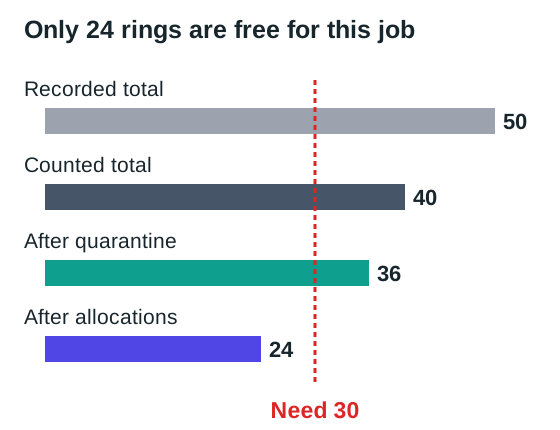
The physical total is ten lower than the record. After keeping the four quarantined rings and the 12 allocated rings out of this kit, only 24 are free. Paula's order is short by six.
| Check | Rings left for this order |
|---|---|
| System total less quarantine and existing allocation | 34 |
| Physical total less quarantine and existing allocation | 24 |
| Required for 30 kits | 30 |
| Shortfall after the physical check | 6 |
Before you release the job, ask stores to reconcile the discrepancy and obtain a real answer for the six missing rings. Keep the other order's allocation visible. Moving somebody else's allocation is a business decision with an effect on that order, not an inventory correction.
Separate three questions before starting
First, does the material physically exist where the next operation can receive it? A receipt expected this afternoon is different from stock on the rack. A part sitting at a supplier or in a different building may still need transport, receipt and any required checks.
Second, is it usable for this operation? Keep quarantine, rejected parts and unfinished inspection separate from released stock. A matching part number does not give a planner authority to change its quality status.
Third, is it already promised elsewhere? Subtract the allocations that the business intends to honour. If two job kits both count the same available stock, each can look complete until one team takes the parts.
In the example, the same four quarantined and 12 allocated rings are included in both the system total and the physical total. They are subtracted once from each view. Keep that definition clear when comparing two reports; subtracting an allocation twice can invent a shortage just as easily as ignoring it can hide one.
Infor's production-order shortage documentation describes checking material before release, including receipts, issues and other consuming orders. The report depends on inventory records. A physical discrepancy still needs to be resolved through the stock process.
Give the hold a person and a time
Use a small release record beside the schedule. Make the distinction between expected and confirmed readiness obvious enough that the next shift does not mistake one for the other.
| Field | Paula's order |
|---|---|
| Required quantity | 30 rings, one per kit |
| Confirmed usable and free | 24 rings |
| Missing quantity | 6 rings |
| Release state | Held for material |
| Owner | Alex, the stores lead, for the count and missing stock |
| Next action | Confirm receipt and release of six rings |
| Next scheduling check | Monday 11:00: Alex confirms receipt status; planner reviews the remaining assembly slot |
Use a specific check time in your real record. "Chase material" gives the next planner neither a dependable follow-up nor a clear person to call. The 11:00 check is due even if no stock has arrived. If arrival is uncertain, keep it uncertain and use the check to agree the next action rather than treating a hopeful date as a confirmed start.
The inventory record should be corrected by the responsible team using the site's normal transaction process. A separate planning note can preserve the discrepancy and its effect while that happens. Quietly changing the schedule to fit a false stock number leaves the next order exposed to the same problem.
Recheck the slot when the material becomes ready
Suppose stores confirms the six rings are received, checked and usable at 13:00. Paula can assemble from 13:00 to 15:00 and meet the 16:00 due time. That answer uses the confirmed release, Paula's calendar and a complete two-hour slot.
If usable receipt moves to 14:00, the same work finishes at 16:00. There is no remaining time before the due date. If a later receipt removes the required continuous slot, report the changed finish and ask for a date decision. Do not shorten the operation merely to keep the original promise green.
For an order of 24 kits, the available rings would cover the requirement. For 25 kits, the same stock would leave one ring short. Record the missing quantity against each order, so a smaller order is not held because a larger one is short.
A partial release needs its own approved plan. Confirm whether the batch can split, what quantity the next operation needs and whether an extra setup follows. Do not send an incomplete kit to the bench simply because some work could start.
Keep progress and readiness different
Material readiness says an operation can start. Completion says the preceding work has actually produced an accepted quantity. Use the work-in-progress handoff check when material is a subassembly coming from another department; "mostly complete" may still leave Paula without enough usable units.
Once the kit is ready, return to the people and equipment check. The bench or the qualified person may have been assigned elsewhere while stores investigated. Current scheduling inputs keep that later plan tied to what is now true.
Before releasing tomorrow's most exposed order, ask stores to confirm the usable, unallocated kit. Keep any missing quantity, its owner and the next check beside the order until the release is supported by the parts on the floor.
ArchiPlan Editorial publishes our planning guides. Artyom Rabzonov is responsible for product and editorial direction.
Artyom on LinkedIn · ArchiPlan on LinkedIn · How we check examples