
Frozen production schedule: stop rebuilding tomorrow for every new order
Set a production schedule freeze that protects prepared work. Check the cost of an urgent insertion and name who can approve changes inside the time fence.
The floor has prepared tomorrow's jobs, and another order has just become urgent. Protect that prepared work inside an agreed near-term time fence. Change it only after a named person accepts the displaced orders and their new dates.
A freeze is a rule for making changes. The planner still updates actual progress, material shortages and breakdowns. Keeping a known impossible plan untouched would hide the problem the rule is meant to control.
The insertion looks small on Monday
Take a made-up job shop with one mill and its qualified operator, Nina. They work 08:00–12:00 and 13:00–17:00. The jobs below have ready material, tooling and approved programs. Each duration includes setup and processing, and each batch must finish its operation without crossing the break. Nothing can run without Nina.
Monday and Tuesday are fully booked. The production lead has agreed that those two days are frozen because materials, setups and customer arrangements have already been prepared. A new 90-minute spacer job arrives on Monday at 09:00, due Wednesday at 10:00.
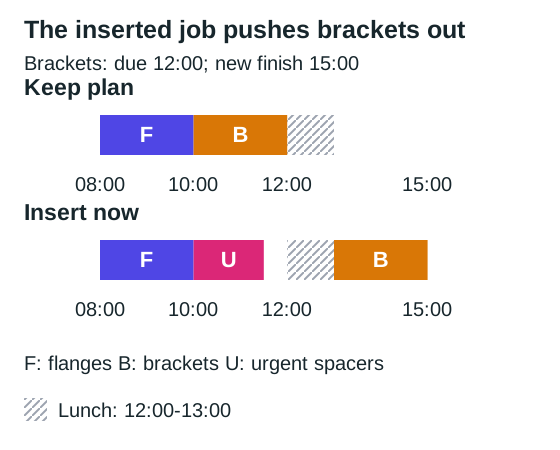
The running flanges stay in place until 10:00. If the spacers go next, they finish at 11:30. The brackets need two uninterrupted hours, so they cannot use the short slot before lunch. They start at 13:00 and finish at 15:00 instead of 12:00.
The housing job behind them needs a continuous four-hour slot. It cannot fit in what is left of Monday, so it moves to Tuesday morning. That pushes the remaining queue out too.
| Order | Frozen plan finish | Finish with Monday insertion |
|---|---|---|
| Flanges | Monday 10:00 | Monday 10:00 |
| Brackets | Monday 12:00 | Monday 15:00 |
| Housings | Monday 17:00 | Tuesday 12:00 |
| Shafts | Tuesday 12:00 | Tuesday 17:00 |
| Pins | Tuesday 17:00 | Wednesday 12:00 |
For this comparison, each existing customer's due time is its original finish in the middle column. The flanges stay on time, but the other four promises move. A 90-minute insertion creates more than a 90-minute change because whole operations need usable working slots.
Check the first slot outside the freeze
Keep the agreed Monday and Tuesday sequence. The spacers can run on Wednesday from 08:00 to 09:30 and still meet their 10:00 due time. None of the existing orders needs to move.
Both options meet the new customer's request. One disturbs the prepared queue; the other uses the first free slot after it. Nina and the production lead have a concrete reason to decline the Monday insertion without arguing about whether the new customer matters.
If the spacer due date were Tuesday instead, Wednesday would not meet it. That should trigger the exception decision. The planner would show the affected orders, ask whether the new deadline is real, and bring the choices to the person who can accept the consequences. Writing "urgent" in a priority column is not that approval.
Write down what your freeze protects
Use a short rule the floor and sales team can both understand. Name the resource or production area, the start and end of the protected period, the work it contains and the person allowed to approve a change. Put the current rule beside the working schedule.
| Question | A usable answer for this shop |
|---|---|
| What is protected? | The released mill sequence and its customer dates |
| Until when? | End of Tuesday's staffed shift |
| What keeps updating? | Actual progress, new readiness facts and availability |
| Who can approve an insertion? | The production lead after seeing displaced orders |
| What reaches the floor? | One revised sequence with its issue time |
Choose the period around what your shop actually prepares. A resource with staged fixtures and booked outside support may need a different boundary from a flexible bench with ready stock. Do not copy another factory's number of days and assume it describes your cost of changing work.
Oracle's Time Fence Control documentation describes boundaries within the planning horizon that restrict changes to reduce disruption. Its item-specific settings are product behaviour, not a universal length for a shop-floor freeze.
The operating rule also needs to be understood outside the planning office. Sales can still bring a worthwhile request. They should bring the actual required date and reason, so the planner can test it against a free slot before disturbing released work.
Keep an exception record small
For a proposed change inside the freeze, record the request, its needed-by time, the current affected orders, their proposed new finishes and the decision owner. Keep the original promises visible. A sequence that silently overwrites those dates makes the next comparison impossible.
Use the same current scheduling inputs for both choices. Check material readiness, remaining work, staffing and calendar exceptions before comparing them. A forecast finish based on yesterday's progress is a weak basis for breaking today's freeze.
Once the lead approves a change, issue one updated queue. Identify what is already running, what is next and which later work changed. Record the issue time so Nina can tell whether the printed list beside the mill is current. Withdraw an older instruction rather than leaving two competing priorities on the floor.
Do not freeze away a breakdown
If the mill fails, the availability assumption has changed. Mark it unavailable, preserve work already completed and recalculate the affected finishes. The freeze still helps you avoid moving unrelated prepared work, but it cannot make the unavailable mill run.
Check people and machines together when looking for another slot. A spare machine without a qualified person is not a recovery plan. The choice of planning tool matters less than preserving those facts when the sequence changes.
At the next priority meeting, take a request that arrived after the queue was issued. Test its first free slot, show the orders a faster insertion would move, and agree who can approve that trade-off before the floor starts another setup.
ArchiPlan Editorial publishes our planning guides. Artyom Rabzonov is responsible for product and editorial direction.
Artyom on LinkedIn · ArchiPlan on LinkedIn · How we check examples