
Odoo vs ERPNext for manufacturing: test the order, not the demo
Compare Odoo and ERPNext with one pump-kit order: a BOM shortage, machine bookings, lunch, invoices and the implementation questions to put in each quote.
Choose between Odoo and ERPNext by asking both partners to run the same order from stock through production and invoicing. Both document production-planning functions, so a feature list alone doesn't establish which fits your shop. Compare the proposed edition, hosting and implementation, then choose the workflow your staff can repeat.
Start with a shortage your team can check
Take a made-up 20-person pump manufacturer moving away from separate stock and invoice sheets. An order for 12 pump kits is due Monday at 14:00. Each kit needs one machined housing, two seals and four bolts. There is no scrap allowance in this example, no incoming stock in the opening balance and no material already allocated elsewhere.
The store has 12 housing blanks, 20 seals and 60 bolts. All blanks still need machining. The bill of materials should produce these requirements before anyone talks about a delivery date.
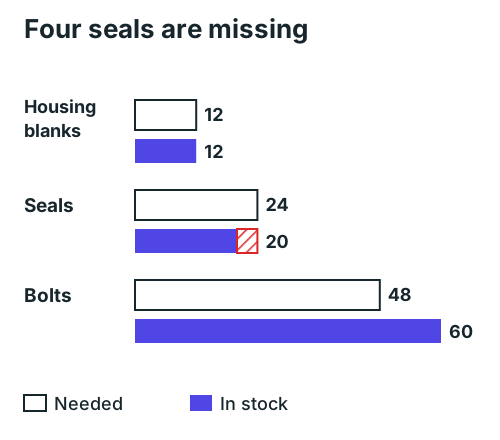
| Component | Per kit | Needed for 12 | Available | Result |
|---|---|---|---|---|
| Housing blank | 1 | 12 | 12 | Covered |
| Seal | 2 | 24 | 20 | Short by 4 |
| Bolt | 4 | 48 | 60 | 12 spare |
Ask the demonstrator to show the shortage in the source warehouse, trace it back to this order and create the purchasing action. Then have your stores person repeat it. A polished dashboard is less useful than a stock figure they can explain.
What the documented workflows give you
Odoo 19's work-center documentation describes working hours, setup and cleanup time, alternative work centers and allowed employees. Work orders require the Work Orders setting. Those are useful starting points for a shop that wants production detail alongside its wider business records.
ERPNext's Production Plan gathers manufacturing demand from sales orders or material requests and supports raw-material planning. Its capacity-planning documentation describes operation timings, workstation availability and generated job cards. That is a useful starting point when you want staff to trace demand through identifiable production records.
Both have documented production-planning functions. Neither description settles how your proposed installation will handle shared operators, alternative routes or a last-minute change. The comparison here is based on documentation checked on 27 October 2026, not a hands-on product trial. Ask each partner to demonstrate the exact edition, version and hosting arrangement they are quoting.
The ownership choices differ. Odoo has Community and Enterprise editions under different licenses, as its official licensing documentation explains. ERPNext is open-source and offers managed hosting or self-hosting. Don't treat "Odoo" as one fixed package or "open-source" as a complete implementation offer.
Hosting can rule out a proposed customization. Odoo's official hosting guidance says Odoo Online is incompatible with non-standard apps. If a partner's solution needs one, ask them to quote a compatible hosting route and its ongoing maintenance. For ERPNext, ask who maintains custom apps and whether the quoted hosting supports them. Settle that before comparing the finished screens.
Use the same acceptance questions for both
| Your test | Odoo starting point | ERPNext starting point | What you should see |
|---|---|---|---|
| Explain the four-seal shortage | BOM and stock records | BOM and Production Plan | Required, available and incoming quantities traced to their records |
| Respect a booked machine and lunch | Work orders and work-center calendar | Work Order operations and workstation hours | A feasible finish and an explanation of any moved work |
| Report partial completion | Ask for the quoted shop-floor workflow | Job Card completed quantity and time logs | Actual quantity, remaining work and stock agree |
| Invoice the right goods | Demonstrate the agreed delivery and invoice route | Demonstrate the agreed delivery and invoice route | No duplicate entry or invoice for unaccepted output |
ERPNext documents completed quantities and operation time logs in its Job Card workflow. Ask Odoo's partner to show the corresponding action in the quoted setup, rather than assuming that a screen shown in another edition is included. Use the same operator and stores person for both demonstrations.
The seals aren't the only reason the order is late
Now run the same order through the floor. Jo is qualified on the mill, which is booked until 10:00. Machining needs 30 minutes of setup plus five minutes for each housing, so the 12 housings finish at 11:30. Jo stays with the machine throughout. Assembly uses a separate bench and Pat, who is qualified for that work.
The four missing seals are received and released for use by 11:00. Assembly needs 15 minutes of setup, five minutes per kit and 15 minutes of final checks: 90 minutes in total. Both resources work 08:00–12:00 and 13:00–17:00. For this process the assembly run must stay together, and the complete batch of machined housings is required before it begins.
The next feasible assembly booking is 13:00–14:30. The order misses 14:00 by 30 minutes even though the seals arrive before machining finishes. Ask each partner to explain that result without changing the original due date or silently allowing work through lunch.
Then move the seal release to 13:30. Assembly should move to 13:30–15:00, making the order 60 minutes late. Machining can keep its original slot because it uses the housing blanks, which are already available. A blanket hold on the whole order would hide that distinction.
These are expected results under the stated rules, not measured results from either product. If a system proposes splitting assembly or transferring a partial batch, have the partner identify that assumption. Accept it only if your real process permits it. The broader ERP versus APS test helps when the unresolved question is scheduling depth rather than which ERP to adopt.
Put implementation and ownership into the quote
Ask both partners for the same written scope: stock cleanup, opening balances, BOMs, routings, calendars, user roles, training, invoice requirements, migration checks and support after launch. Name who owns each item. Your production scheduling inputs need an owner before either system can use them reliably.
ERPNext's official pricing explanation separates hosting and implementation and provides a self-hosting route. Open-source software still needs someone responsible for backups, upgrades and support. Odoo's public pricing page could not be retrieved during this check, so obtain a current written quote rather than using a headline subscription figure from another comparison.
For both offers, record paid users, applications, hosting, customizations, integration work, migration, training, ongoing support and upgrade responsibility. Compare the total scope at launch and during normal operation. Ask who will repair a custom workflow after an upgrade, and have that responsibility included in the offer.
Choose the workflow your staff can repeat
Keep Odoo on the shortlist when the quoted edition and hosting support your required workflow without an unresolved add-on. Keep ERPNext on it when the demonstrated workflow fits and the hosting, customization and support responsibilities are covered. The documentation doesn't establish a winner for this shop. A partner who can demonstrate the complete order and leave your staff able to repeat it has a stronger offer than one who leaves those steps unresolved.
Before signing, give each partner the pump-kit order and ask your stores person, planner and accounts colleague to carry it through. Keep the unresolved steps and the cost to close them beside the quote. Choose after your staff can explain where the four seals come from, when the kits finish and what gets invoiced.
ArchiPlan Editorial publishes our planning guides. Artyom Rabzonov is responsible for product and editorial direction.
Artyom on LinkedIn · ArchiPlan on LinkedIn · How we check examples