
Job shop scheduling: choose the next job across different machines
Choose the next job across shared machines. Compare two checked job shop schedules, keep whole-batch handoffs, and see which due dates each choice misses.
The next job on the mill may still have to wait for the lathe. Compare the complete routes before choosing the queue order. Keep the same due dates for each choice, then look at which orders finish late rather than which machine starts first.
Two urgent orders share the same machines
Take a made-up machining shop with one mill and one lathe. Anna runs the mill and Ben runs the lathe, so the machines can work at the same time. Both people work 08:00–12:00 and 13:00–17:00. All material, tools and programs are ready at Monday 08:00. Neither order has started.
The flange order is 20 pump flanges. It needs two hours on the mill, then two hours on the lathe, and is due at 12:00. The bushing order is ten motor bushings. It needs one hour on the lathe, then one hour on the mill, and is due at 10:00. Those durations include setup, processing and handover. Each whole batch passes to its next operation; there is no partial transfer or splitting across lunch.
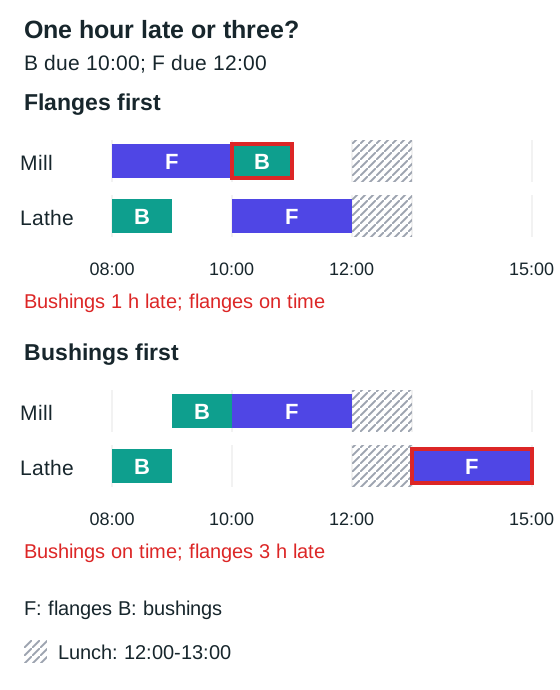
The bushings have the earlier due date. Running their route first sounds sensible. But the mill would wait until the lathe releases them at 09:00, then finish them at 10:00. The flange milling would take 10:00–12:00. Their two-hour lathe operation would then wait through lunch and run 13:00–15:00. The bushings meet their date; the flanges finish three hours late.
Check the other feasible sequence
Start the flanges on the mill at 08:00 while Ben turns the bushings on the lathe. The bushings are ready for the mill at 09:00, but Anna continues the flanges until 10:00. She then mills the bushings from 10:00 to 11:00 while Ben turns the flanges from 10:00 to 12:00.
| Choice | Bushings finish | Flanges finish | Total time late |
|---|---|---|---|
| Flanges first on mill | 11:00, one hour late | 12:00, on time | One hour |
| Bushings first on mill | 10:00, on time | 15:00, three hours late | Three hours |
Both choices are physically possible. Neither meets both original promises. If your agreed aim is to reduce the sum of time late, flanges first is the better of these two choices. If the bushing order has a contractual consequence that outweighs the flange delay, the business may choose differently. Write that reason beside the sequence.
Do not call either choice the best possible schedule for a real shop. This comparison contains two orders, fixed durations and two specific sequences. Extra machines, different staffing or an approved batch split would create other choices. The useful result is that you can explain the trade-off before releasing the work.
Put one row against each operation
An order list with a single start and finish hides the handoffs. Give each operation its own row. Keep the order number and a short part name together so the floor can recognise the work.
| Order | Operation | Needs | Cannot start before | Duration |
|---|---|---|---|---|
| Pump flanges | Mill | Mill and Anna | Material ready | Two hours |
| Pump flanges | Turn | Lathe and Ben | Whole flange batch milled | Two hours |
| Motor bushings | Turn | Lathe and Ben | Material ready | One hour |
| Motor bushings | Mill | Mill and Anna | Whole bushing batch turned | One hour |
For each proposed start, check the previous operation's finish, the machine's next free slot and the required person's availability. Then find a continuous working slot long enough to finish the operation. The latest of the readiness times is the earliest candidate start; the calendar may move it later.
That last check explains the flange delay. At 12:00 the lathe is free, but a free resource is not the same as an available working slot. The next two-hour staffed slot starts at 13:00. Do not draw a bar through the break unless the actual operation and staffing rules permit it.
Microsoft's job-scheduling documentation describes assigning detailed jobs to resources and synchronising related jobs. That supports checking the route at operation level; it does not supply a universal priority rule for your shop.
Use a short comparison at the board
When a machine becomes free, start with work that is genuinely ready. Exclude jobs waiting for material, an approval or a preceding operation. For the remaining jobs, look beyond the time on the machine in front of you.
- Write the next operation and its required person beside each candidate.
- Place one candidate, then follow its batch to the end of the route.
- Place the work it displaces on every shared resource.
- Repeat with the other credible choice, keeping durations and due dates unchanged.
- Compare final finishes and agree whose promise changes.
Keep completed work and running operations fixed during this check. A comparison that moves something already machined is not a choice the floor can take. If a running operation can stop, use the shop's approved restart and setup rules rather than assuming it resumes without cost.
When a local priority rule stops helping
An earlier due date is useful information, but it cannot describe the whole route. The bushings' early deadline encouraged a choice that left the mill waiting and put flange turning after lunch. Looking only at mill utilisation would miss the customer's three-hour delay.
The same issue appears when several routes feed assembly: completing more loose components does not necessarily complete another finished order. Track the accepted quantity at each handoff so that a neat sequence does not send an incomplete batch forward.
Shared operators add another check. Anna and Ben are separate people here. If one person tends both machines, check their attended setup and inspection times before overlapping the bars.
As the number of shared routes grows, use the same checked case when choosing a scheduler. Ask it to preserve the handoffs and show the late orders. A picture with every machine busy is not enough evidence that the plan serves your due dates.
For tomorrow's queue, choose the two jobs whose order is disputed. Follow both routes to their actual finishes and show the comparison to the person who can approve the changed customer date.
ArchiPlan Editorial publishes our planning guides. Artyom Rabzonov is responsible for product and editorial direction.
Artyom on LinkedIn · ArchiPlan on LinkedIn · How we check examples